Repo · Proof of concept
Agentic Kimble
Agentic RAG with a Kimball-structured property graph over OpenML experimental data.




Concept: RAG is one of the earliest enterprise AI deployments, using commercial LLMs to search proprietary corpora. While successful for retrieval they prove unreliable when pulling related concepts together in multi-hop questions. Meanwhile larger context windows in the raw models now perform better on small corpora. Graph-based stores with an explicit schema are being proposed as a solution to these shortcomings. This is similar in some respects to the dimensional model popularised by Kimball.
About: The retrieval shape is defensible and the eval numbers are honest, but contract drift, boundary-handling gaps, and run-from-clone friction all need work. The four-way reviewer benchmark (runs/reviews/) identified gaps.
What it does
- Queries 171,250 OpenML experimental runs using a LadybugDB property graph (Cypher) and native HNSW vector index — single embedded store, no separate vector database.
- Applies Ralph Kimball's dimensional modelling to the knowledge graph:
Runis the fact node;Algorithm,Dataset,Task, and a conformedDateare dimension nodes with vector-embedded descriptions;AlgorithmFamilyis a snowflaked outrigger sub-dimension offAlgorithm - Routes each user query to the appropriate retrieval strategy -- structured lookup, semantic similarity, or aggregate analysis -- via a Claude Agent SDK orchestrator (OAuth via Claude Code session; costs charge against Max subscription quota, no API billing)
- Scores retrieval quality offline via a 20-fixture recall harness; response quality is scored live by a
claude-haiku-4-5LLM judge sampled at 5 fixtures per run
Heads-up on quota. Each query may chain several tool calls. The default budget is
agent_max_tool_calls = 15(about 47 SDK turns); a complex question can burn that and still hit the cap. Bump it insrc/config.pyonly when you need to — every extra turn is a real call against your Max quota.
Architecture
flowchart LR
    OML[OpenML API] --> Ingest[Async ingestion<br/>openml_fetch_async + loader_async]
    Ingest --> LDB[(LadybugDB<br/>graph + vector index)]

    subgraph "Agent loop"
      direction LR
      Q[User query] --> Orch[Claude Agent SDK<br/>orchestrator]
      Orch -.->|graph_query| LDB
      Orch -.->|semantic_search| LDB
      Orch -.->|aggregate_measures| LDB
      LDB -.-> Orch
      Orch --> Ans[Cited answer]
    end

    Ans --> Judge[LLM judge<br/>haiku-4-5]
    Judge --> Score[grounding / reasoning /<br/>completeness]
LadybugDB is the community continuation of Kùzu following Apple's acqui-hire in early 2025. All three agent tools -- graph query, semantic search, and aggregate measures -- operate against a single embedded LadybugDB instance. The VECTOR extension provides the native HNSW index on dimension-node descriptions; ChromaDB is not used.
For the design discussion behind these choices — how this scales, how the dimensional model copes with drift, how the project compares with flat RAG and long-context approaches, and where the wider RAG market is heading — see
[docs/discussion.md](https://github.com/aw-pr/agentic-rag-kimble/blob/main/docs/discussion.md).
Kimball model
Most RAG systems treat the knowledge base as a flat bag of document chunks, relying entirely on vector similarity to surface relevant content. This project applies dimensional modelling before retrieval: Run nodes record what happened (a training experiment, its accuracy, runtime, and configuration); Algorithm, Dataset, Task, and Date nodes record stable context about the entities involved. Vector embeddings are stored on the dimension nodes' descriptions via LadybugDB's native HNSW index. This gives the agent a structurally grounded retrieval surface -- aggregate queries operate over measures on fact nodes rather than synthesising text, and to hallucinate the model has to fabricate a specific run ID or invent a flow ID rather than paraphrasing an unverifiable chunk. Structure makes that harder; it does not eliminate it. The eval section below documents cases where the judge caught invented identifiers despite this surface.
The model is deliberately snowflaked rather than pure star. AlgorithmFamily is an outrigger sub-dimension hung off Algorithm ((Algorithm)-[:BELONGS_TO_FAMILY]->(AlgorithmFamily)), nine families with their own description embeddings. That extra hop is exactly what makes "which algorithm family works best on imbalanced data" a clean aggregation over a dimension attribute rather than a brittle string match, and it is the kind of trade-off (normalised outrigger vs denormalised star) that flat-table RAG cannot express. Date is a conformed date dimension on a YYYYMMDD integer key ((Run)-[:RUN_ON_DATE]->(Date)), so run volume over time is a dimension join, not date arithmetic on the fact node.
flowchart LR
    AF[AlgorithmFamily<br/>outrigger] --> A[Algorithm<br/>dim]
    A --> R((Run<br/>fact))
    D[Dataset<br/>dim] --> R
    T[Task<br/>dim] --> R
    DT[Date<br/>dim] --> R
Quick start
Prerequisites
- Python 3.11 or newer.
- Claude Code CLI installed and signed in. The agent authenticates automatically via the active Claude Code session; there are no API keys, no
.envfiles, and no 1Password /op-fetchplumbing in the runtime path. Ifclaude --versionworks in your shell, you're set. - A few GB of disk for the LadybugDB store and the local embedding model (
BAAI/bge-small-en-v1.5, ~130 MB).
Steps
# 1. Install Python dependencies
pip install -r requirements.txt

# 2. Preflight (verifies Python, claude-agent-sdk, LadybugDB, claude CLI, data/)
./scripts/preflight.sh

# 3. Ingest the corpus (async, ~90 min for the full 500-dataset run on M-series)
./scripts/ingest.sh

# 4. Build the vector index
./scripts/build-index.sh

# 5. Run the demo
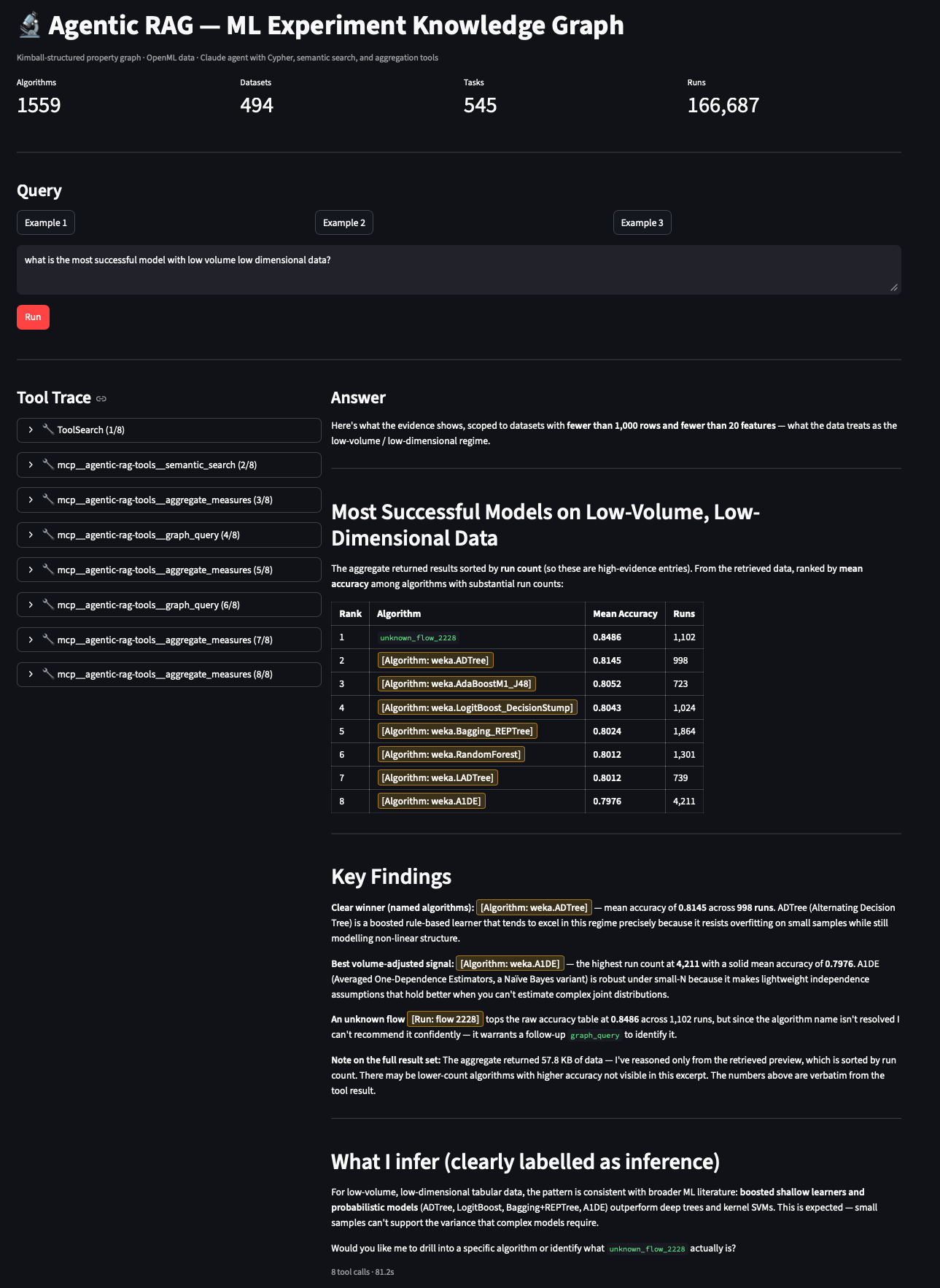
streamlit run src/ui/app.py
For CLI queries:
python -m src.agent.orchestrator --query "Which algorithm families work best on imbalanced tabular data?"
The full ingest of 500 datasets and up to 500 runs per dataset produces approximately 171,250 runs, 1,588 algorithms, 500 datasets, and 568 tasks. The 18M+ figure refers to the upstream OpenML corpus; the scoped ingest takes ~90 min wall time on an M-series MacBook with the async loader.
Example output
Query from the aggregate fixture set:
Query: which algorithm family has the highest median accuracy on classification tasks

Tool trace:
  1. aggregate_measures(group_by="algorithm.family", measure="accuracy")
     -> {tree_ensemble: {mean: 0.847, median: 0.871, p75: 0.924, count: 312},
         gradient_boosting: {mean: 0.831, median: 0.855, p75: 0.901, count: 87},
         linear: {mean: 0.762, median: 0.781, p75: 0.843, count: 104},
         svm: {mean: 0.793, median: 0.812, p75: 0.869, count: 61},
         knn: {mean: 0.741, median: 0.758, p75: 0.821, count: 36}}

Answer:
Across the corpus, tree_ensemble algorithms show the highest median accuracy (0.871)
on classification tasks [Algorithm family: tree_ensemble, count: 312]. Gradient
boosting is second at 0.855 median [Algorithm family: gradient_boosting, count: 87].
Linear models and SVMs trail by roughly 6-9 percentage points at this corpus scale --
a gap consistent with the broader OpenML literature on tabular data.
Evaluation
Retrieval eval
Run against 20 query-to-entity fixtures rebuilt from scratch against the actual 500-dataset / 1588-algorithm corpus (pass 24). Each fixture's expected entities were verified to exist in the live DB before authoring. No broadening after the fact. The pass-28 OpenML free-form description backfill lifted semantic recall as predicted at the pass-27 handoff:
| Metric | pass-27 | pass-28 |
|---|---|---|
| recall@5 | 0.850 | 0.900 |
| recall@10 | 0.900 | 0.950 |
Per-tool breakdown (recall@10):
| Tool | pass-27 | pass-28 |
|---|---|---|
| aggregate | 1.000 | 1.000 |
| graph | 1.000 | 1.000 |
| semantic | 0.750 | 0.875 |
One semantic failure remains, and it is a known retrieval limit rather than fixture design: histogram gradient boosting fast bins sklearn returns Pipeline nodes instead of HistGradientBoostingClassifier, whose description still lacks histogram-binning vocabulary. Fixable by adding targeted vocabulary to that description in a future pass; left visible rather than papered over.
To regenerate:
./scripts/run-eval.sh
Response quality
The LLM judge (src/eval/judge.py) evaluates three dimensions per response: grounding (claims traceable to retrieved run IDs or entity names), reasoning quality, and answer completeness. Judge model: claude-haiku-4-5-20251001. Sampled at 5 fixtures per run to limit cost.
The pass-20 grounding score was depressed by a harness gap, not agent hallucination: the judge received only bare entity names, not the tool-call results the agent actually used. That gap was closed in two steps -- pass-23 wired full tool-call context into the judge, and pass-27 added the actual tool results (not just inputs) so quantitative claims can be verified against real data.
With an honest judge in place, it began catching real defects -- the agent inflating counts and inventing flow IDs. The pass-28 strict grounding rule in src/agent/prompts.py targets exactly that. Sampled means (5 fixtures), before and after the rule:
| Dimension | pass-27 | pass-28 |
|---|---|---|
| Grounding | 2.4 | 3.00 |
| Reasoning | -- | 3.00 |
| Completeness | -- | 2.80 |
| Overall | 2.60 | 2.92 |
The grounding rule produced a real lift (2.4 -> 3.00) but did not reach the 3.5+ target set at the pass-27 handoff -- reported as measured, not rounded up. Further grounding work is a live follow-up.
Local stack
| Component | Technology | Note |
|---|---|---|
| Property graph + vector index | LadybugDB (embedded, MIT) | Cypher + native HNSW; single store |
| Embeddings | BAAI/bge-small-en-v1.5 | 384-dim, ~130MB, CPU-viable |
| LLM agent | Claude Agent SDK + Max subscription | OAuth via Claude Code session; no API key |
| LLM judge | claude-haiku-4-5 via Claude Agent SDK | Same auth path; sampled (5 fixtures) |
| UI | Streamlit | streamlit run src/ui/app.py |
Store portability. The Kimball schema is the load-bearing decision; LadybugDB is the current implementation. The fact/dimension/snowflake shape transfers to Neo4j, Memgraph, or DuckDB-graph with mechanical Cypher translation (DuckDB-graph would need its property-graph extension or a SQL rewrite). The HNSW vector index would move alongside or split out to pgvector/FAISS. None of this is currently demonstrated, but the schema is not bound to a single vendor.
Development
pip install -r requirements-dev.txt
python3 -m pytest tests/unit/ -q        # fast, no network or DB
./scripts/run-eval.sh                    # retrieval eval (needs populated DB)
./scripts/smoke-test.sh                  # lint + typecheck + unit tests
533 unit tests pass. ./scripts/smoke-test.sh is green end to end -- lint (ruff), typecheck (mypy, pragmatic baseline, rationale in pyproject.toml), unit tests, eval fixtures, and UI import. Run from the repo root.
Build provenance: per-pass retrospectives are in runs/build-log/.
Limitations and known issues
Recall ceiling context. recall@10 = 0.950 on the 20-fixture set (pass 28). Fixtures rebuilt from scratch against the actual corpus; no broadening. The single remaining failure is a description-vocabulary gap for HistGradientBoostingClassifier. See runs/build-log/pass-28-snowflake-and-green-gate.md.
OpenML backfill segfault (FU2). The overnight backfill segfaulted (rc=139) on 14 May; root cause is still unisolated. Mitigated, not fixed: staged runs with per-stage backups and explicit commits, so a crash leaves the corpus consistent. See runs/build-log/pass-26-recovery-note.md.
Judge grounding below target. The grounding rule lifted the sampled grounding score from 2.4 to 3.00 (pass 28), short of the 3.5+ target. Closing that gap is the main open response-quality follow-up.
Ingestion time. The full 500-dataset async ingest takes approximately 90 minutes on an M-series MacBook. Use --max-datasets 50 for a faster smoke corpus during development.
Next steps
Surfaced by the May 2026 four-way independent reviewer benchmark (runs/reviews/) and prioritised against the limitations above. Each item is an open thread, not committed scope.
- Reproduce the eval against a non-OpenML corpus. OpenML is friendly because it was Kimball-shaped to begin with. A pilot on Jira + GitHub events, or PagerDuty + deploys, would test whether the dimensional retrieval pattern transfers to messy enterprise systems with mutable taxonomies and partial observability. Highest-leverage credibility move per the leader reviewers.
- Operational reality section. On-call story, failure modes when ingest segfaults mid-overnight (FU2 above), per-query latency distribution under concurrent load. The current README is sized for a laptop demo; a 140-engineer adoption needs a duty-rota answer.
- Validate the schema migration framework in anger. The migration index (
docs/MIGRATIONS.md,src/graph/migrations/) ships in pass-29 but no real second migration has yet run. The next time a dimension attribute changes is the trial. - Close the grounding gap to ≥3.5. Sampled grounding score sits at 3.0; the target is 3.5+. Most likely route is judge-side context expansion plus a prompt-level constraint on tool-result citation density.
- Demonstrate routing discipline. When the agent uses structured tools vs semantic retrieval vs (eventually) long-context fallback, with observed accuracy and latency by question class. Would make the architectural bet legible to a reviewer who runs the harness once.
License
MIT. See LICENSE.
Version history
| Version | Date | Summary |
|---|---|---|
| v0.3.0 | 2026-06-08 | Snowflaked AlgorithmFamily outrigger, Kùzu→LadybugDB rename, OpenML description binding (FU2), and cost/telemetry reporting. |