Folder Explainer
Back to folderResearch Explainer · Jumper (2021)
AlphaFold predicts protein structures with near-experimental accuracy, but sequence alone still sets the boundary
AlphaFold combined evolutionary information with explicit geometric reasoning to outperform every other method at CASP14. Its predictions are fast and unusually accurate, provided the sequence carries enough evidence about the structure.
Published August 2021
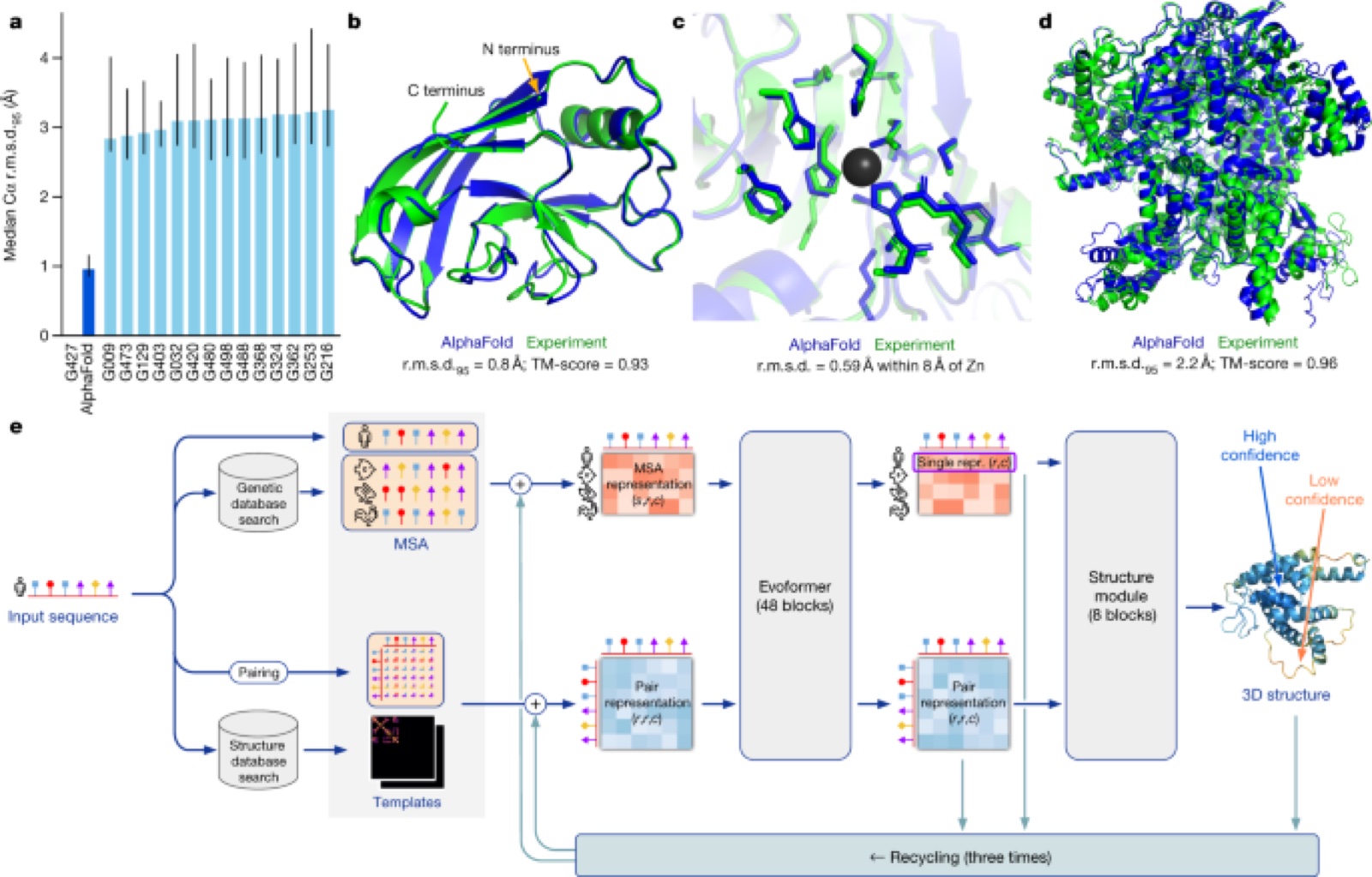
0.96 Å median CASP14 backbone error, compared with 2.8 Å for the next-best method
1.5 Å median all-atom error, compared with 3.5 Å for the strongest alternative
1.1 min of GPU inference time for a 384-residue protein without ensembling
A decisive result at CASP14
Protein sequences are plentiful, but experimentally determined structures are not. AlphaFold tackled that gap by predicting the three-dimensional arrangement of a protein's atoms directly from its amino-acid sequence, assisted by related sequences and any useful structural templates.
At CASP14, the field's blind structure-prediction assessment, AlphaFold achieved a median backbone error of 0.96 Å across 87 domains. The next-best method reached 2.8 Å. Its median all-atom error was 1.5 Å, against 3.5 Å for the strongest alternative.
The result was not confined to a competition set. Across 3,144 recently deposited Protein Data Bank chains without close templates in the training data, median backbone error was 1.46 Å. Structure prediction had stopped looking like an elaborate approximation, at least for the proteins that played by the rules.
| Evaluation | Metric | AlphaFold | Best alternative |
|---|---|---|---|
| CASP14, 87 domains | Median backbone r.m.s.d.95 | 0.96 Å | 2.8 Å |
| CASP14, 87 domains | Median all-atom r.m.s.d.95 | 1.5 Å | 3.5 Å |
| Recent PDB set, 3,144 chains | Median backbone r.m.s.d. | 1.46 Å | Not reported |
Evolution meets geometry
AlphaFold begins with the target sequence, a multiple-sequence alignment and, when available, homologous structures used as templates. The alignment reveals which residues have changed together through evolution, a useful clue that they may interact in the folded protein.
The model does not treat this evolutionary record and the emerging geometry as separate problems. Its Evoformer repeatedly exchanges information between representations of the aligned sequences and every residue pair, using attention and triangle-based operations to reason about mutually consistent spatial relationships.
A structure module then turns those representations into three-dimensional backbone frames and atom coordinates. Recycling sends the provisional prediction through the network again for refinement. The model therefore behaves less like a lookup table and more like a very persistent geometer.
The prediction pipeline has three tightly connected stages.
- Gather evolutionary evidenceBuild a multiple-sequence alignment and collect any available homologous structures as templates.
- Reason over residues and pairsUse the Evoformer to update sequence and pair representations through attention, triangle multiplicative updates and triangle self-attention.
- Construct and refine coordinatesUse invariant point attention to predict backbone frames and atom positions, then recycle the result through the network.
Training beyond the experimental archive
The supervised training set contained Protein Data Bank structures released by 30 April 2018. Proteins were randomly cropped to 256 residues, and training on 128 TPU v3 cores took about one week, followed by four days of fine-tuning.
Experimental structures were still scarce relative to the number of known sequences, so the authors used self-distillation. An earlier model generated predicted structures for 355,993 Uniclust30 sequences, and final training sampled 75% of its examples from this enlarged set and 25% from clustered experimental structures.
Five models were trained with different random seeds and template settings, with the highest-confidence prediction selected for each target. AlphaFold learnt from its own answers, but only after the experimental record had taught it which answers deserved trust.
Confidence, scale and the remaining gaps
AlphaFold estimates its own local confidence using predicted local distance difference test scores, or pLDDT. Across 10,795 chains, pLDDT tracked observed accuracy with a Pearson correlation of 0.76. Predicted TM-score, a measure of confidence in the overall fold, correlated with measured TM-score at 0.85. These estimates let researchers separate convincing regions from decorative fiction.
The system is fast enough to change experimental practice. A 256-residue protein took about 0.6 GPU minutes to predict, rising to 1.1 minutes at 384 residues without ensembling. Predictions can assist molecular replacement and the interpretation of cryogenic electron microscopy maps, making computation a practical opening move rather than a last resort.
The limits are equally instructive. Accuracy falls when a multiple-sequence alignment contains fewer than roughly 30 effective sequences, while gains above about 100 are modest. Proteins shaped mainly by interactions with other chains remain difficult because this version does not directly model complete hetero-complexes. Ligands, ions, alternative stoichiometries and conformational states may also be invisible from sequence alone.
Long sequences add a computational sting: a 2,500-residue protein took about 2.1 hours, memory use scaled roughly quadratically, and proteins above about 1,300 residues generally exceeded a 16 GB V100 GPU. AlphaFold compressed much of structural biology's search problem, but biology retained a few hiding places.
WHAT CHANGED
AlphaFold turned high-accuracy protein structure prediction into a practical computational tool, pairing near-experimental results with confidence estimates that show where the model is likely to be right. It does not replace experiments when structure depends on complexes, ligands or alternative states, but it changes which experiments need to begin from scratch. The sequence now supplies an unusually good first draft, while nature keeps the editing rights.
Reference
Jumper, J., et al. (2021). Highly accurate protein structure prediction with AlphaFold. Nature. https://doi.org/10.1038/s41586-021-03819-2